
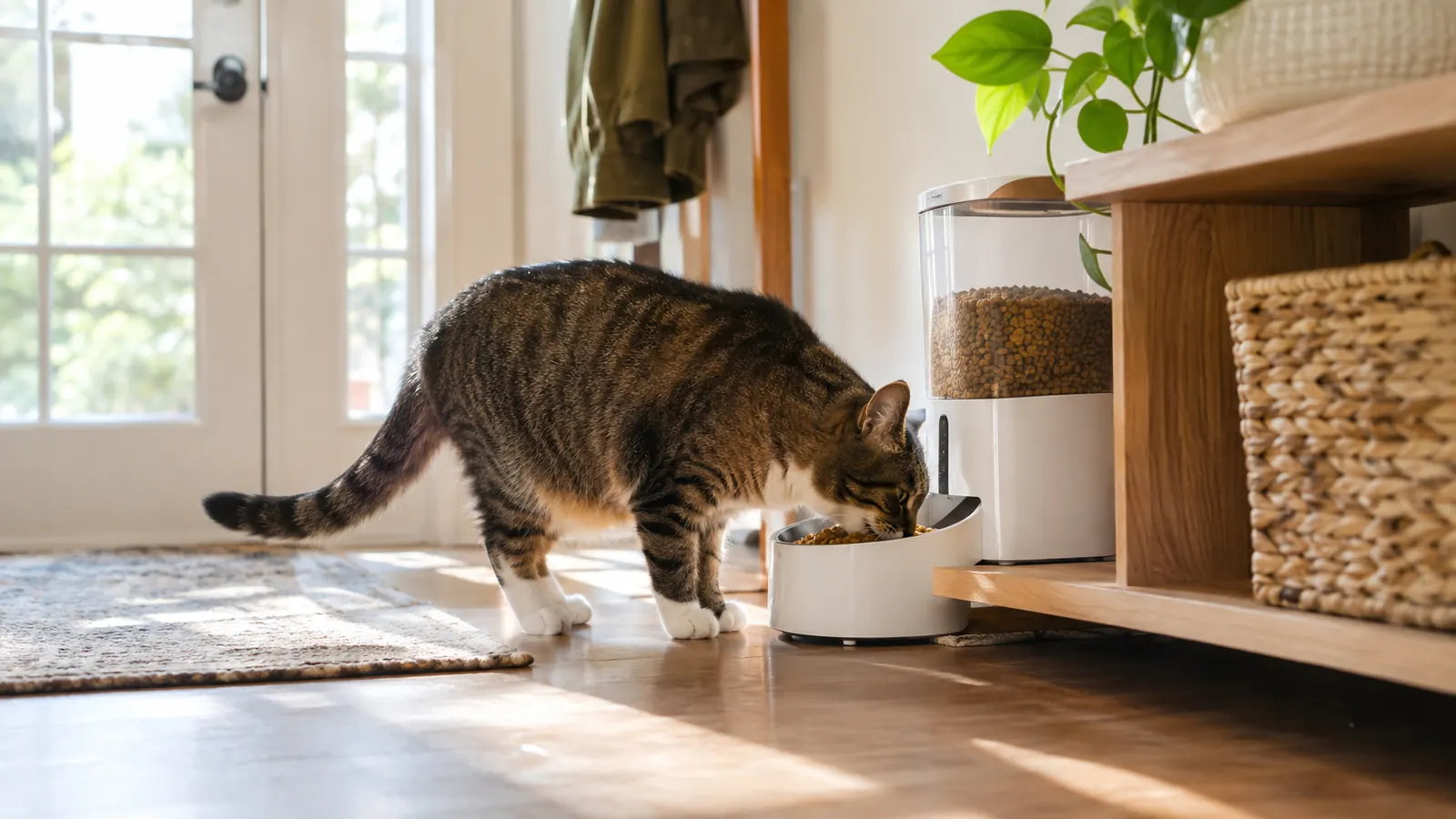
Pepper turned five this spring, and somewhere along the way she decided that she, not the alarm clock, was in charge of the morning. At 4:15 a.m. most days she would plant her front paws on my chest and knead until I gave in. If I stayed in bed, she moved to my hair and then to the lamp cord. On weekends she would tip over the sealed kibble bin in the pantry, gnaw the corner open, and eat until she felt sick. Free feeding had worked when she was a kitten, but for an indoor five year old tabby, an open food supply just made her anxious and a little overweight.
The turning point was when I stopped being the one who delivered breakfast. I put a programmable automatic feeder in charge of the schedule. I chose the Voluas automatic feeder because the 4 liter container holds enough dry food for a long stretch and the meal timer is easy to set. The real work came before I pressed a single button. You need a sensible spot, a daily portion you can defend, a schedule that fits your household, and a short adjustment period for the cat. Then the machine does what it is supposed to do, every morning and every evening, while you stay in bed.
Stop the 4:15 a.m. wake-up call by scheduling two meals a day
Put the Voluas 4 liter automatic feeder in your mudroom, set the portion and the time, and let the meals appear on their own. It took about an hour for me to get everything dialed in. Check today's Amazon listing for delivery options.
Amazon Check Today's Price on Amazon →Step 1: Put the feeder somewhere Otis cannot reach it
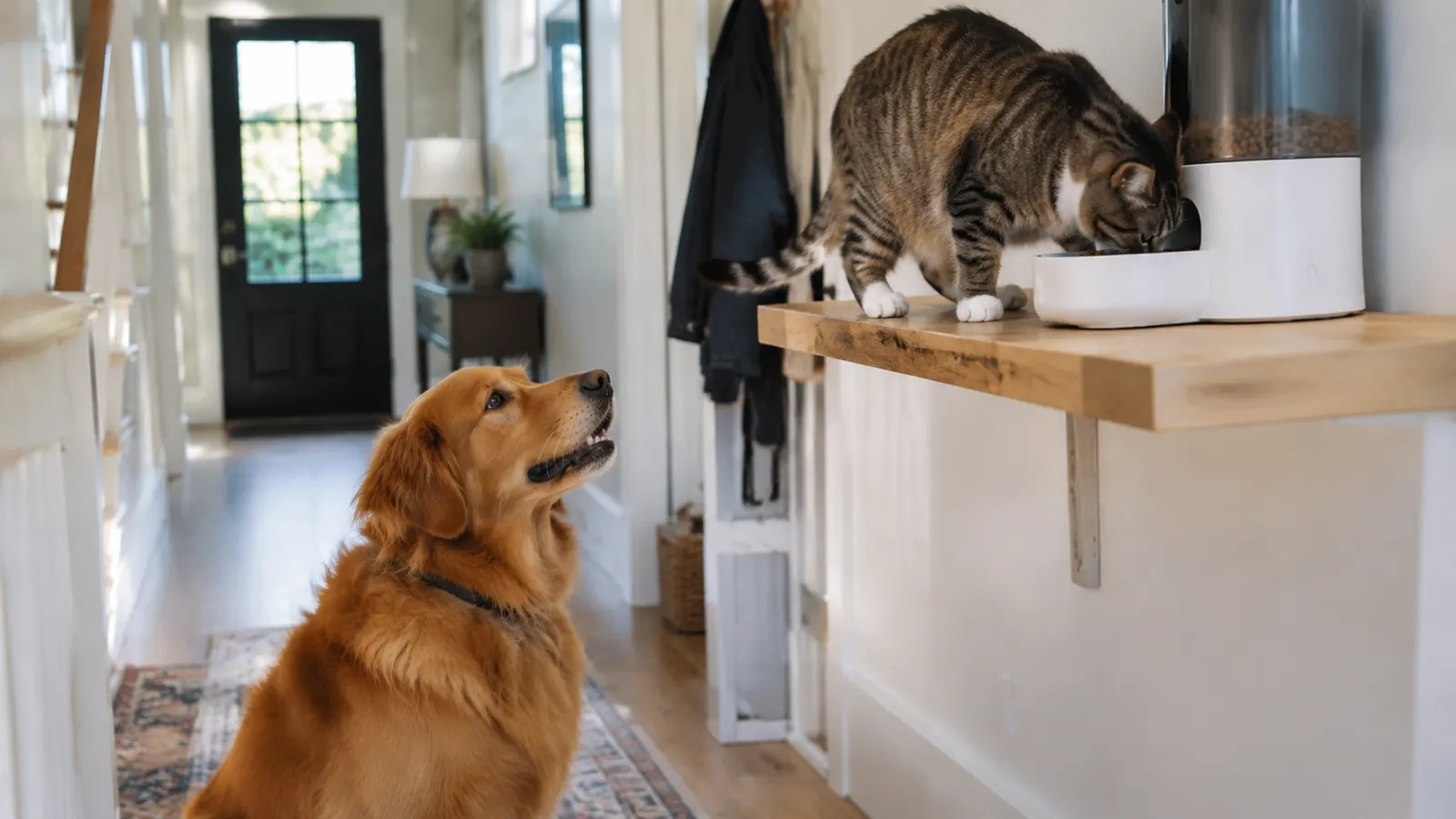
The first thing I learned is that a feeder on the floor is just a bowl a dog can reach. I placed the Voluas feeder next to Pepper's old bowl, filled it, and went about my day. That evening I found Otis, my 68 pound Labrador mix, licking the last crumbs out of the tray while Pepper sat on the stair and gave me a look that usually means disappointed. In one night, the automatic feeder had turned into a dog feeder. The fix was simple: move it up. I put it on a wide shelf in the mudroom, just above the bench, where Pepper jumps easily and Otis cannot get his nose over the front edge even when he stands tall.
Location matters for other reasons too. Cats are creatures of habit, and Pepper expects her meals near the mudroom door where she can watch what is happening outside. The shelf I chose is directly above her old feeding spot, so she found the feeder without help. If I had moved the food to a strange corner of the kitchen, she would have sat next to her old bowl and cried while the feeder sat full and ignored. Put the feeder where the cat already looks for food.
Keep the feeder away from water bowls. Dry food crumbs can fall into the water and make the whole area smell, and cats are picky about the water they will drink. I keep Pepper's water on the other side of the mudroom, well away from the feeder. That little change cut down on the number of times I had to rinse the water bowl and kept the feeder tray from getting sprayed whenever she bobbed her head.
Step 2: Measure the daily portion before you touch the timer
The biggest mistake I see people make with any timed feeder is setting the portion before they know what the cat should actually eat in a day. You have to start with the food, not the machine. I looked at the feeding chart printed on Pepper's dry food bag, then called our vet's office to confirm the calorie target for a five year old indoor cat. The bag number was close, but the vet's answer was better because Pepper is not very active and had already gained half a pound over the winter.
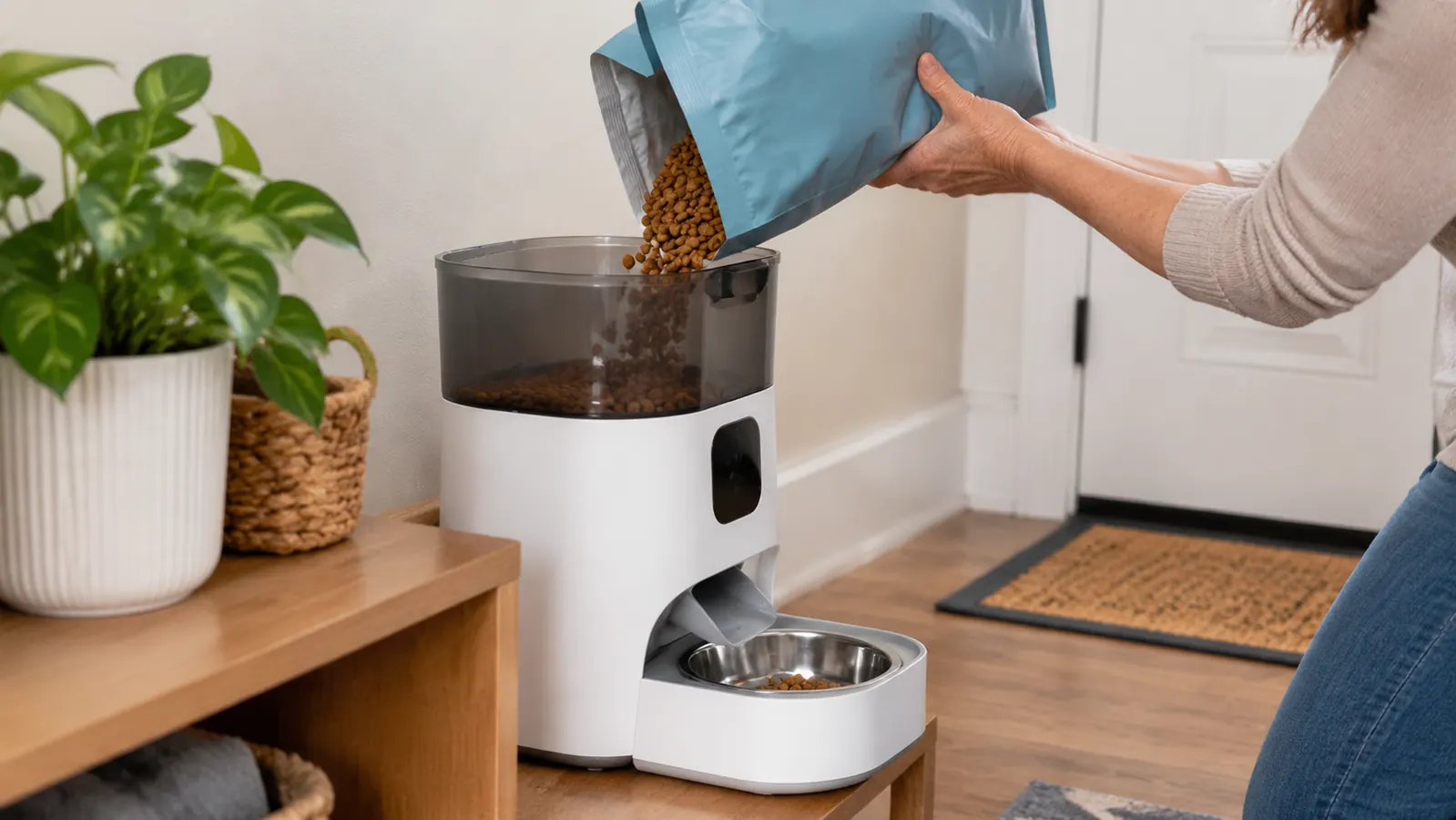
I divided her daily target by the number of meals she already ate, which was two. That became the amount for the 6:30 a.m. and 6:30 p.m. feedings. Then I measured what that amount looked like in the scoop that came with the food, and I matched it to the Voluas feeder's portion setting. On this model the portion control moves in small steps, so there is a setting that is close to my scoop. I used a small kitchen scale for the first week to check my work, and it made a difference because the kibble settles differently in a full hopper.
If you have no idea where to start, start slightly below what the bag suggests, not above. A few days on a slightly smaller portion will not hurt a healthy adult cat, and you can watch what gets left in the bowl. If your cat cleans the bowl for an entire week and starts asking for more, move the portion setting up one step. If food is still sitting there at the next meal, move it down.
Step 3: Set the clock, then program meal times
The order matters. Before I did anything else, I set the current time on the Voluas feeder. A feeder that is five minutes fast will release food when the cat is not waiting, and a feeder that is five minutes slow will make the cat stare at the tray. Pepper knows the exact minute. I set the clock first, then went through the programming menu for meal one. On this model, you choose a meal slot, set the hour, set the minutes, set a portion amount, and confirm the schedule.
I gave Pepper two meal slots a day: 6:30 a.m. and 6:30 p.m. For the morning meal I set the portion amount at the same level I had measured in the previous step. For the evening meal I started with the same portion and planned to adjust later if needed. The display showed a countdown to the next feeding, which told me the feeder was armed and waiting. I walked away, but I kept listening for the first morning delivery.
If your cat is used to three or four small meals, do not assume every feeder supports that many schedules. Check the manual for your specific model and see how many meal slots are available. The product listing for the Voluas feeder clearly shows what it can do, and the manual that arrives in the box gives the exact button sequence. Start with the same number of meals your cat already eats, then move the times gradually if you need to shift them for your work schedule.
Step 4: Let your cat get used to the feeder before you trust it
The transition is where most people give up. They load the feeder, set a schedule, and then blame the machine when the cat hides under the bed for two days. The fix is to go slowly. For the first two days I left the Voluas feeder on the shelf with the power off and the bowl empty so Pepper could sniff it, rub her cheek on the edge, and walk past it. I also put a couple of pieces of kibble in the bowl by hand so she discovered there was a payoff at that spot.
Once she was comfortable, I ran a manual portion while I was standing next to the shelf. The first time the dispenser turned and kibble rattled into the bowl, she flinched and jumped down. I waited a moment, called her back, and let her sniff the bowl before I ran it again. The second time she stayed. By the third time she was sitting under the dispenser waiting for the kibble to fall. That is the reaction you want before you leave the feeder alone for a scheduled meal.
For the first scheduled feedings, I stayed inside the house. It is fine to let the feeder do the work while you are in another room, but I would not want the first automatic meal to happen with no one home. If the kibble bridges and blocks the opening or if the portion is accidentally set too small, you want a human nearby to catch it. I ran two scheduled meals with the feeder watched, and after those went smoothly I stopped worrying.
Step 5: Adjust after the first full week
The real payoff showed up in the second week. By the end of the first seven days, Pepper had stopped sitting near the pantry and had started waiting by the feeder about five minutes before each scheduled time. She lost some of the weight she had gained over the winter, and the 4:15 a.m. wake-up call disappeared almost completely. She still pokes me at 6:15 some mornings because she can hear the feeder motor begin to turn a couple of minutes before it drops, but she no longer stands on my chest demanding that I perform the feeding manually.
I made one portion adjustment in that second week. She was leaving a few pieces of kibble in the bowl most evenings, which meant my original setting was slightly too high. I moved the Voluas portion setting down one step and the leftovers disappeared. That is the process you want to repeat: make a small change, wait a week, then check the bowl again. Do not increase the portion just because your cat is sitting by the feeder and looking hungry, because a cat will always look hungry.
Watch the food level and the condition of the kibble as you refill. The feeder keeps the food dry, but if you top it off with dusty or stale kibble, grain dust can build up near the dispenser opening and make the rotation stick. I wipe the inside of the hopper and the lid with a dry paper towel each time I refill, which is about every ten days for Pepper. The desiccant packet that comes in the lid stays dry, and the food keeps its usual crunch.
The new schedule changed Otis's behavior too. He still walks through the mudroom and sniffs the floor where the kibble used to accumulate, but he has learned that the shelf is out of his range. He has mostly stopped patrolling the area at mealtimes. That is the other reason I would not go back to free feeding with one dog and one cat in the house; the feeder removed the daily argument over food and gave each animal a clear place in the routine.
What Else Helped the Schedule Stick
Setting the feeder solved the biggest part of the puzzle, but I needed a few habits around it. I chose feeding times that worked with the whole household. Our evenings are not the same every day, so I set the evening meal early enough that no one was getting home late and surprised by a bowl of food that had been sitting out. If the schedule changes, it is easy to shift a meal by a few minutes, and Pepper adapts faster than I expected.
I check the feeder tray each evening. The tray is shaped so crumbs stay near the bowl, but I make it part of my nightly routine to look at it before I go to bed. Old food left in the tray can get stale or attract ants in the summer. Since Otis is tall enough to see the shelf, any food that spills over the front edge is gone within an hour, which means I want the feeder sitting far enough back on the shelf that Otis cannot lick at it.
Keeping a small feeding log for the first few weeks helped more than I thought it would. I wrote the time, the portion setting, whether she cleared the bowl, and whether she was sick later. Patterns showed up that my memory had missed. When I moved the evening meal thirty minutes later, Pepper started waking closer to six. When I moved it too close to her bedtime, she was restless at night. The log let me tune the schedule one step at a time.
Finally, remember that this style of feeder is built for dry kibble. If your cat eats canned food or prescription food that does not flow easily, you can use the feeder for the dry portion and give the wet food by hand at separate times. That keeps the wet food from spoiling in the tray while still giving you the benefit of a consistent dry meal schedule.
By the end of the second week, Pepper had stopped waking me at 4:15 a.m. and was waiting by the feeder at 6:25 a.m., with Otis watching from the floor below the shelf.
Give your mornings back to yourself
If your cat is running the feeding schedule the way Pepper used to run mine, a timed feeder is worth trying. The Voluas 4 liter automatic feeder holds enough food for about ten days for a single cat and lets you set the exact times. Check today's Amazon listing for details and delivery dates.
Amazon Check Today's Price on Amazon →