
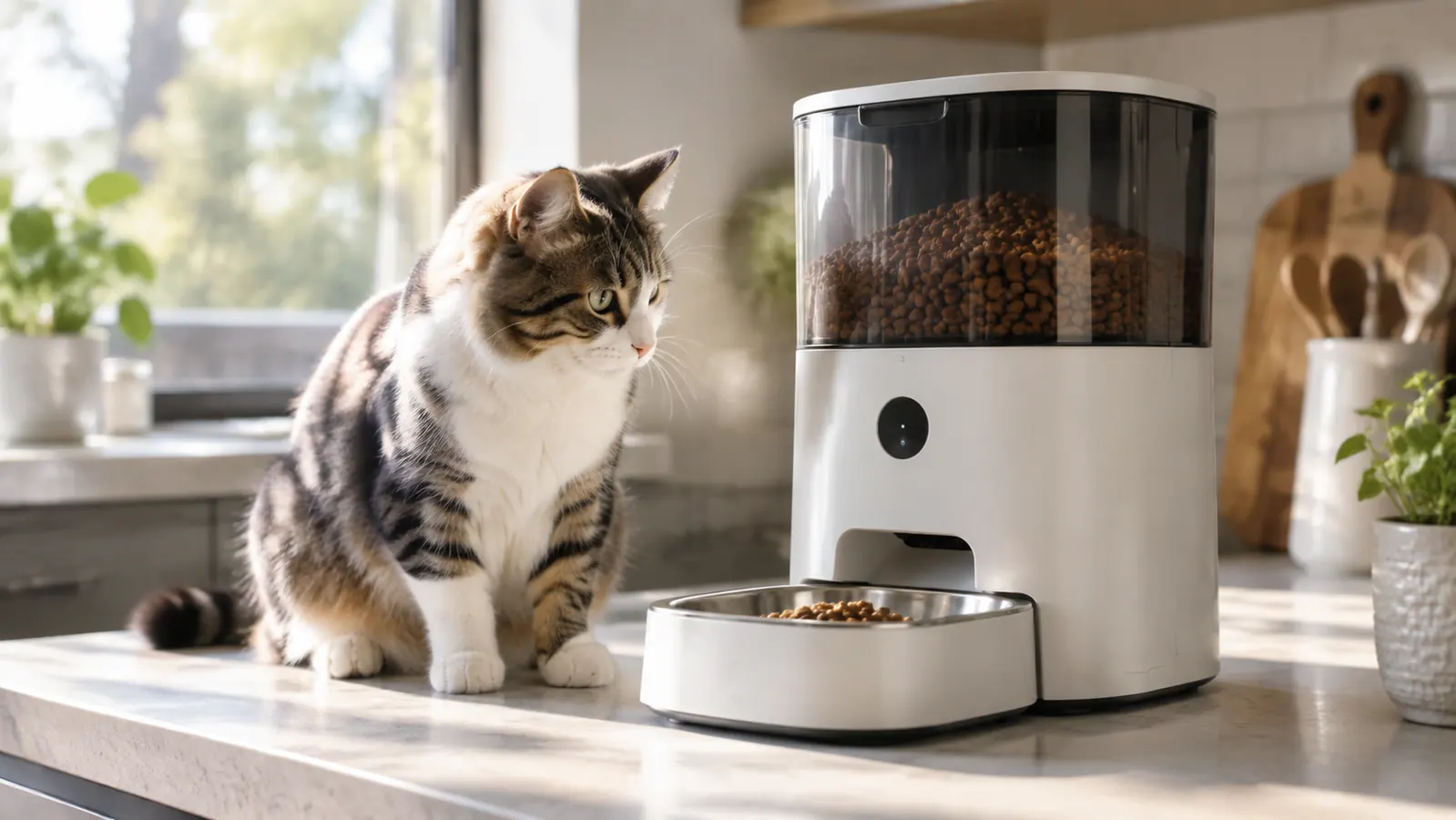
I bought the Voluas automatic feeder for one reason: Pepper was waking me at 4:45 every morning. Not a gentle paw on my shoulder. A full feed-me-now routine that involved knocking the water glass off the nightstand on three separate occasions. I work irregular shifts, so depending on me for breakfast is not a workable plan. After the second broken glass I ordered a feeder, this four-liter Voluas model, and set it up the same night it arrived. I have now used it every day for eight weeks, through two work cycles, one overnight trip, and one bad cold that kept me in bed until noon. This is the honest review I wished I had found before I bought it.
You can find a dozen feeders in this category on Amazon, and the reason I chose this one is not very exciting. The size fits on my kitchen counter without hanging over the edge, the portion settings go high enough that I could use it for Otis if he ever got close, and the review scores for food delivery were mostly positive. What worried me were the complaints about the app and the cleaning. I wanted to know if those issues mattered after daily use. So I kept a notebook for the first two weeks, measured portions, and paid attention to the small things the marketing photos never show.
The Quick Verdict
Worth the money if you need a feeder that feeds on schedule and you can accept a weekly cleaning routine. The app has rough edges, but after eight weeks the feeding itself has been reliable.
Amazon Check Today's Price →Does the Voluas Feeder Earn Its Place on the Counter?
After eight weeks with Pepper, I can tell you what works and what gets on my nerves. If you want a feeder that feeds the same time every day and you do not expect phone perfection, this one earns its keep. Check the current price on Amazon and read the rest of my notes below.
Amazon Check Today's Price on Amazon →How I've Used It
Mine sits on the kitchen counter next to the coffee maker, far enough from the sink that water splashes never reach the base. Pepper is a five-year-old shorthaired tabby, indoor only, and she eats three small meals a day. I set the Voluas to release a quarter cup at 6:15 a.m., noon, and 6:00 p.m. The four-liter hopper holds about eleven days of food for her, assuming she does not knock anything loose. Otis, my 68-pound Labrador mix, is the reason the feeder is not on the floor. If it were, he would treat it as an expensive puzzle box and probably win. He is not the target for a two-pound feeder.
I tested it over a weekend when I left Friday evening and came back Sunday afternoon. The feeder handled all three full days of meals with no one home, and every portion landed on schedule. The next test was a nine-day stretch where I traveled and a friend checked on the animals once daily. She texted me that the feeder had never gone more than a day without food. At the end of that week I weighed the remaining kibble and compared it to the portion log in the app. The math was close enough that I stopped counting portions at night.
The feeder is not silent. It makes a low whir when the internal part turns, then a few pieces of kibble tumble into the tray. Pepper knows that sound from two rooms away. At night the 6 p.m. meal lasts about three seconds, so it has never woke me up. But if your pet eats in the bedroom and you are a light sleeper, you will hear it.
Setting It Up: What the Manual Does Not Tell You
The hardest part of setup was not the feeder. It was the app. The Voluas app asked me to create an account, pair the feeder over Bluetooth, and then join it to my home Wi-Fi. My router broadcasts the 2.4 and 5 GHz bands under the same network name, so the connection failed repeatedly. I eventually had to turn off the 5 GHz band for ten minutes, connect the feeder, and turn it back on. If you have a dual-band router, do that before you pull your hair out. I also recommend writing down the app's unit of measurement because you will need it later.
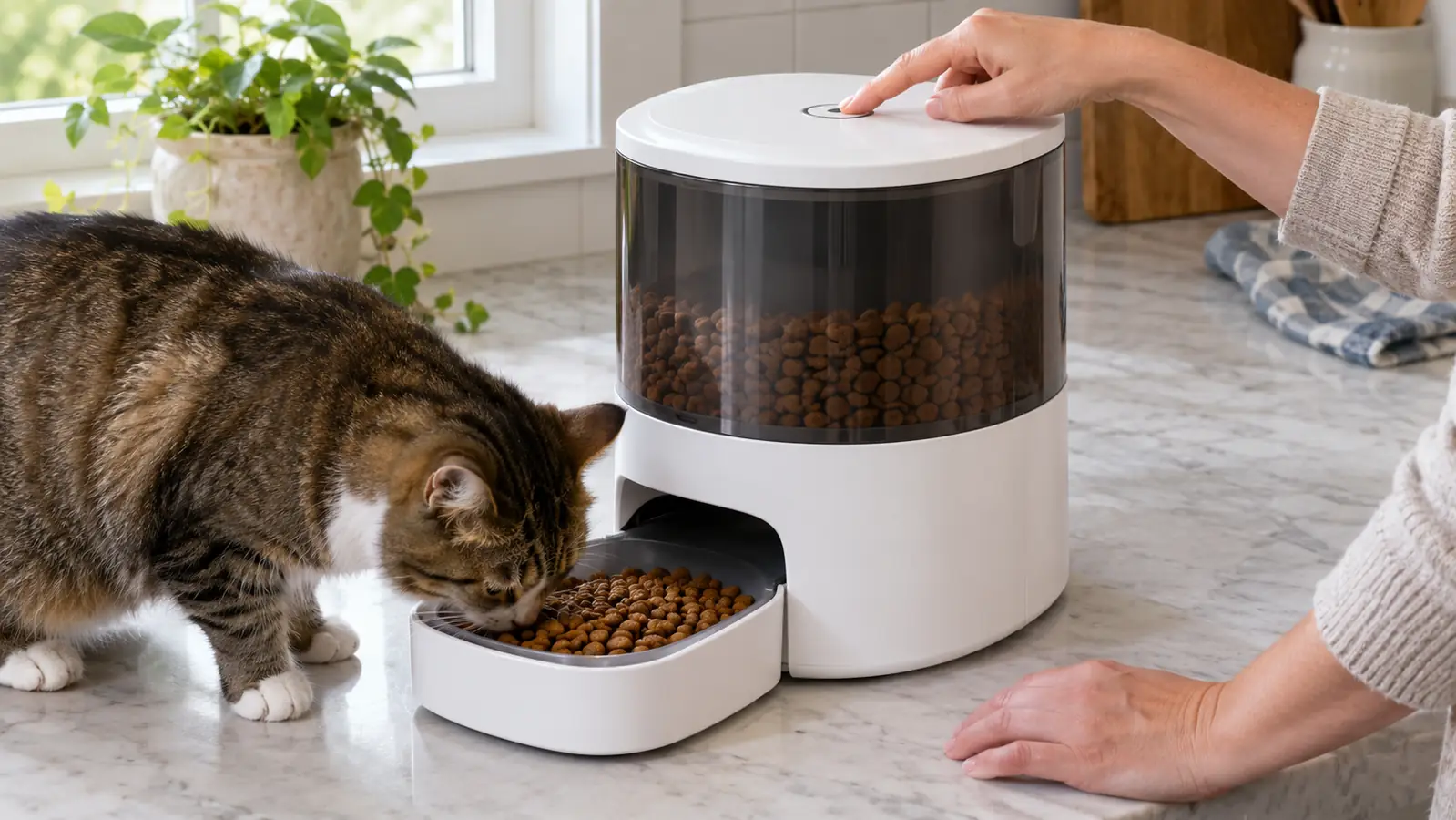
Once connected, I entered the three mealtimes and tested the manual button hidden under the lid. That button dispenses without the app, which is useful when the Wi-Fi acts up. I also discovered the tray locks into the base only when it is pushed all the way forward. The first time I did not push it firmly enough, the next scheduled portion slid behind the tray and spilled onto the counter. A small rubber strip on the back of the tray keeps it level, but that strip can pop out during washing. You can fix it with a minute of fidgeting, but it is a design detail no review photo shows.
Filling the hopper also takes a bit of care. The lid hinges at the back and does not detach. If you pour kibble too high, the lid will not close flush because the kibble blocks it. I fill to the line marked on the inside wall, which is about three quarters full. When I topped it up to nearly full, the kibble sat unevenly and caused a gap above the opening. The feeder still worked, but I had to shake the hopper to settle the food. The owners manual eventually explains this, but you have to read it before that first refill.
Everyday Reliability: What Really Happened
In eight weeks I have had one missed meal, and the miss was my fault. At the start of week three I switched from the small round kibble Pepper usually eats to a bag of larger, oddly shaped pieces that I was trying to use up. The larger pieces bridged above the dispensing mechanism, and at 6 p.m. the feeder whirred but nothing fell. I came home to a hungry cat and a feed log that showed zero portions dispensed. When I swapped back to the standard small kibble, the problem disappeared. The manual says the feeder is designed for small dry food, and it is not exaggerating.
Aside from that, the scheduled meals ran on time. I kept a simple log on my phone for fourteen days. The 6:15 a.m. feeding appeared at 6:15, the noon at noon, the 6 p.m. at 6:00. There were no early meals, no late meals, and no times when the feeder failed to register a portion. The portion log in the app gave me a time stamp for each event, which is exactly what I needed when I was not in the room. The feeder also stores the last few entries even when the Wi-Fi is off.
I did test the voice message feature, because the box promises it. You record a message on your phone and the feeder plays it before the food drops. In practice, my phone recorded a quiet message that was slightly lower than the motor. Pepper paid more attention to the mechanical click than to my voice. I turned the message off after the second day because she already comes running when she hears the motor. If your cat is trained to respond to your voice, your results may differ.
I also paid attention to what happened when things went wrong outside of scheduling. During a storm in December, the power went out for about an hour and a half. I braced for a wrong clock when it came back, but the Voluas reset itself to the correct time. It immediately dispensed the meal it had missed, logged it in the app at 8:47 p.m., and went back to its schedule. I also lost internet for most of a morning. The feeder kept feeding, the app showed an offline warning, and once the network came back it synced the missing entries on its own.
Cleaning and Maintenance: The Part Nobody Posts About
The maintenance schedule is the part of this review I want to write in big letters. You cannot set this feeder up and ignore it for a month. I clean mine every Sunday, and it takes about five minutes. The plastic hopper lifts straight up, the stainless tray slides out, and the dispensing paddle inside the base comes out for a rinse. The lid, however, does not come off. You can wipe around it with a damp cloth, but a brush will not reach the corner underneath the hinge. After a month, a fine dust had collected there, and that dust comes from normal kibble rubbing against the lid.
The stainless tray is dishwasher-safe on the top rack, and I run it through the dishwasher when it gets slippery. The hopper and the base are not dishwasher-safe, because the electrical contacts live in the center of the base. To clean the hopper I wash it by hand with warm soapy water, rinse it, and dry it completely before I put it back. If I let it air-dry upside down, water pooled inside the rim and ran into the motor housing. Again, I am telling you this because I did it. It did not break the feeder, but it made the motor sound wet for an afternoon, and I did not want to risk a second round.
The impeller, which is the part that pushes food into the tray, needs a little more attention. Kibble dust and bits of broken food collect around it. If I skip a third Sunday, the impeller starts to turn sluggishly. A quick rinse and dry fixes it. I also wipe down the chute where food falls with a paper towel after every hopper refill. It takes ten seconds and keeps the moving part from sticking. The bottom line is that this feeder rewards a small weekly routine and punishes anyone who wants true zero upkeep.
One more note about the outside. The plastic around the tray and the lid collects fingerprints faster than I expected. I wipe it with a soft cloth while I am cleaning the inside, and that keeps it looking fine. A scrubby sponge leaves tiny scratches in the plastic, so I avoid it on every surface except the stainless tray. The clear window on the front is easy to smudge, so I clean that last with a dry side of the cloth.
The App: Why I Almost Gave Up in Week One
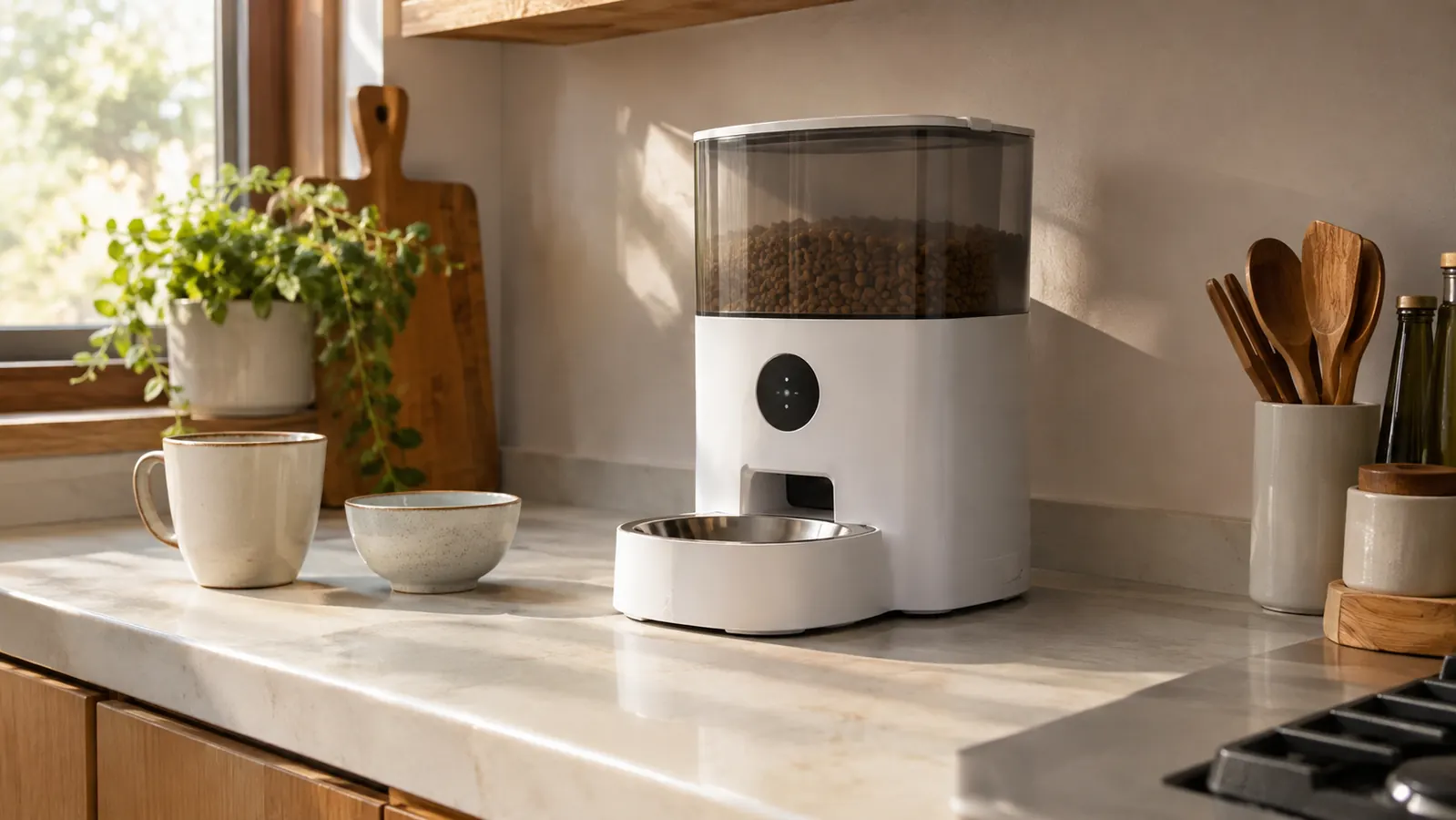
The app is the weakest part of the Voluas experience. The main screen looks clean, but the menus bury important settings. To change a portion size you tap the meal time, tap the wording next to the portion button, choose a preset or a custom number, and then save. I missed the custom option until the third day because the screen does not draw attention to it. The app also wants to connect directly to the feeder over Wi-Fi, so it does not always update if your phone hops to a different band. This is annoying, not dangerous. The feeder keeps its own schedule, which means it feeds even when you cannot reach the app.
One detail you will need is that portion sizes are measured in grams, not cups. The app lets you pick from one to nine portions or enter a custom number of grams. The manual does not state what a single portion weighs. I solved this by pressing the manual button ten times into a kitchen scale. Ten portions came to 83 grams, which works out to 8.3 grams per portion. My usual quarter cup of Pepper's kibble weighed about 22 grams, so I set the feeder to three portions, roughly 25 grams, and adjusted after a few days. The feeder does not tell you when the hopper is nearly empty either, so you have to look at the clear window on the front.
Once the schedule is set, the app behaves. Notifications arrive on my phone each time the feeder dispenses, including the time and portion number. I have used those notifications to confirm that the morning meal happened before I am even out of bed. The app also keeps a meal history for the last week or so. If my household changes, I can program a new mealtime in about thirty seconds. It is not as polished as the app on a much more expensive feeder, but it does what this one needs to do. The only limitation I noticed is that the app connects to one phone at a time, so my backup phone cannot pull up the same history at the same time.
What I Liked
- Delivered scheduled meals on time for eight weeks, with one miss caused by the wrong kibble shape
- Four-liter hopper saves frequent refills; about eleven days of food for one cat
- Manual button works without Wi-Fi and saved me during a router issue
- Notifications log each meal and give you a record when you are not home
- Tray slides out and is top-rack dishwasher safe
Where It Falls Short
- App setup is fussy with dual-band Wi-Fi and hides the custom portion setting
- Portion sizes are shown in grams, not cups, and the manual does not explain them
- Lid is fixed in place, so dust collects under it
- Large or oddly shaped kibble can bridge and cause a missed meal
- Voice message feature is quieter than the motor and not useful for my cat
The one missed meal in eight weeks was my fault, not the feeder's. I filled it with larger kibble and the mechanism jammed. Small, round kibble has never missed.
Who This Is For
This feeder is right for you if you need a feeding schedule that happens without you. It is good for cats and small dogs that eat dry food, for people who work shifts, and for pet parents who travel overnight and want to leave a limited, measured amount of food. It also suits someone who wants a record of when food went down, because the app keeps those timestamps. If you are willing to spend five minutes every Sunday cleaning it and a few extra minutes setting the schedule, the Voluas does what it promises.
Who Should Skip It
Skip it if your pet eats wet food or a mix that needs refrigeration. Skip it if you want a feeder that lives on the floor beside a large dog, because a determined dog will knock it over or pry the lid. Skip it if you need the app to be flawless, because the app has rough edges and you will need to keep the 2.4 GHz Wi-Fi available. And skip it if you will not keep up with the cleaning. A dusty impeller will eventually stick. None of those warnings make the feeder bad. They just make it not right for every home.
My Bottom Line After Eight Weeks
The Voluas automatic feeder has earned its spot on my counter. It feeds Pepper on time, it tells me when it has fed, and it is simpler to clean than I expected. The app is the weak point, and the shape of your kibble matters more than you would think. If your cat or small dog needs a reliable schedule, this feeder is worth a look. Check today's price on Amazon.
Amazon Check Today's Price on Amazon →