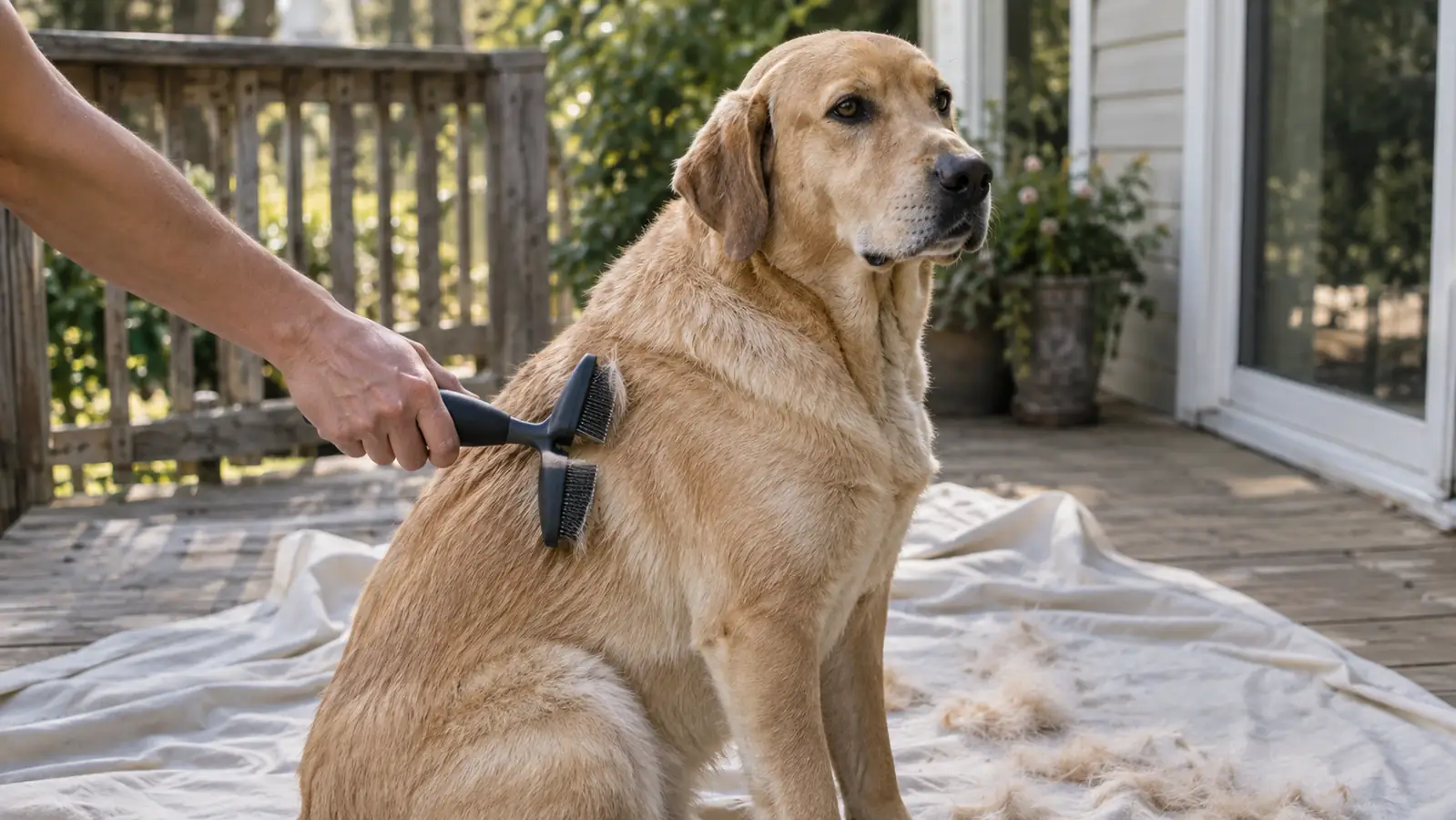
Otis sheds like it is his full-time job. He is a 68-pound Labrador mix, and every spring the hair comes off him in tufts that drift across the downstairs hardwood like small tumbleweeds. I owned a FURminator for years, the stainless steel deshedding tool that seems to sit in every dog-owning household I know, and I assumed it was the only tool that could keep up. Then a neighbor asked me a question I could not answer. She has a shepherd mix with an undercoat twice as thick, and she wanted to know whether the Thunderpaws 2-in-1 Deshedding Brush and Dematting Rake actually cuts more hair than the FURminator or just makes a louder claim online. I bought one, put it head to head with my old FURminator on the same dog, and kept notes for eight weeks.
The short answer, after all those weeks and roughly four grocery bags of collected fur, is that the Thunderpaws removed more hair per session on Otis's thick undercoat, and it handled the tangles the FURminator simply slid over. The FURminator still has a place in my routine, and for a dog that never mats it may be all you need. But for a heavy shedder who misses the occasional session, the Thunderpaws is the better buy, and it costs less up front. Here is exactly how I tested both, and where each one honestly won.
How I Tested Both Tools
I set a routine so neither tool got an unfair advantage. Every other morning, before breakfast, I took Otis onto the back porch and brushed each side of his body with a different tool. Ten long passes down his back, ten on each flank, five across his chest, then the same count on the other side. I spread the same old sheet beneath him each time and swept the fallout into a paper bag marked with the date, so I could see, not just feel, which tool was doing more. On the first heavy-shedding session the difference was obvious. The FURminator side filled a sandwich bag. The Thunderpaws side filled the same bag and needed a second one.
I also kept track of how Otis voted. He is seven years old and stiff in the back legs on cold mornings, so he does not like being bent and twisted for a long grooming session. When a tool pinched or pulled, he leaned away or let out a low grumble. I gave a demerit for every grumble, every flinch, and every time he tried to stand up and walk off. I timed the whole session as well, from the first pass to the moment the tool was clean and back on its hook, because a brush that takes five minutes to clear is a brush that stays in the mudroom.
A note on the cat before I get to the results. Both tools say they work on dogs and cats, and both got the same response from Pepper, our five-year-old tabby. She allowed four tolerant passes on her back with each one, then she was done. Neither tool pulled at her skin, so if a cat is part of your plan, either brand will work. Just keep the sessions short and quit while the cat is still willing.
The two tools also asked different things of me as the one holding them. The FURminator has a single working head and a handle I have used for years, so I already knew its rhythm. The Thunderpaws asks you to flip the handle to switch from the rake end to the brush end, which felt clumsy for the first week. I kept trying to brush with the rake or rake with the brush. By the second week the flip became automatic, and by the end of the test I could switch ends without looking down. That learning curve is real, and it is the main reason I tell people not to judge the Thunderpaws on the very first session.
What Each Tool Does Differently
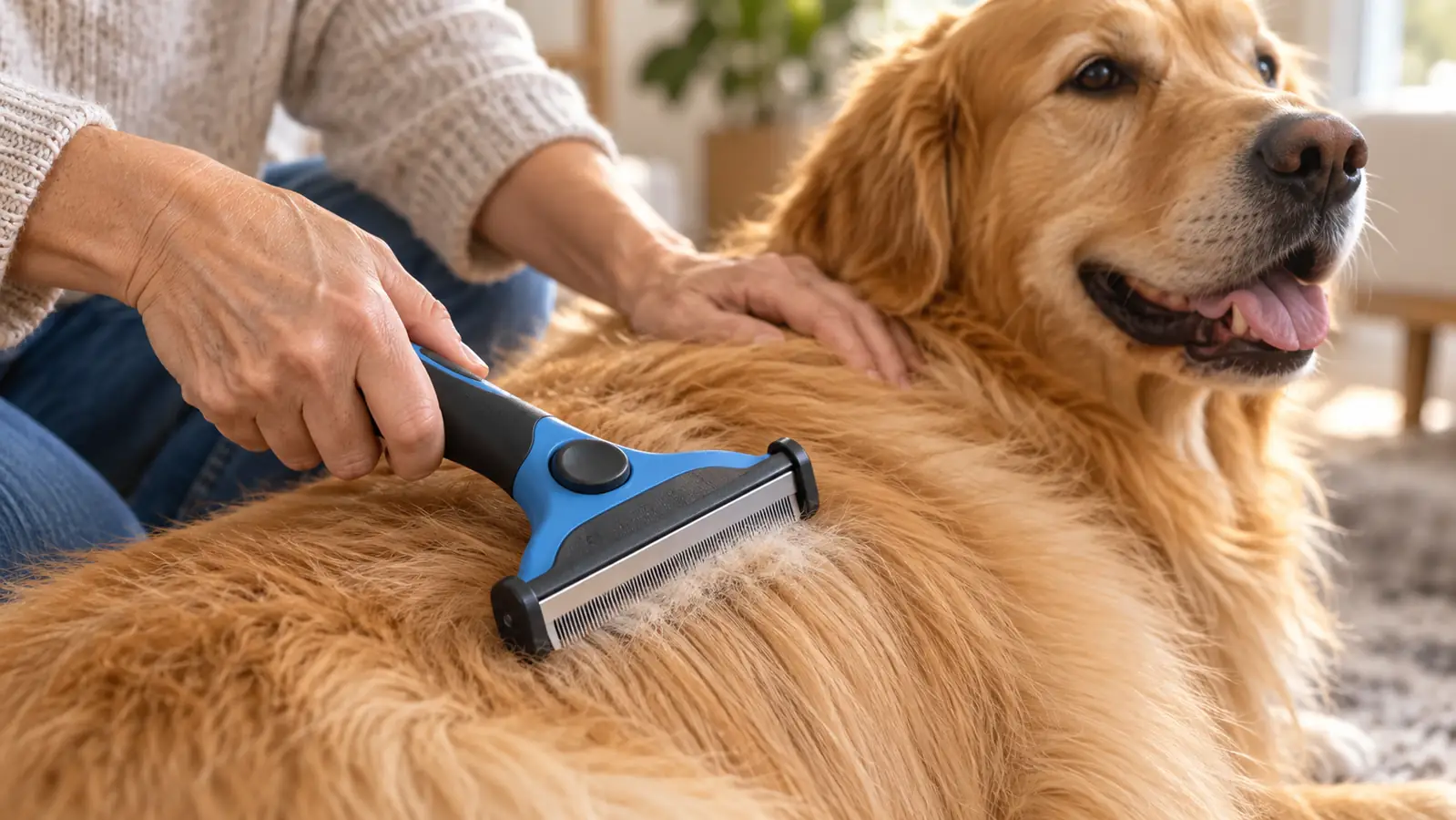
The FURminator has been around long enough that its design is the default picture most people have of a deshedding tool. A single row of stainless steel teeth sits in a handle, and a blade edge along the bottom reaches through the topcoat and hooks the loose undercoat underneath. A button on the handle ejects the collected hair, which is genuinely useful when you are working through a coat in full shed. It is a proven design, and on a calm dog that is brushed regularly it does its job very well.
The Thunderpaws 2-in-1 takes a different approach. One end of the handle is the deshedding brush, with a row of teeth that pull the loose undercoat the same way the FURminator edge does. The other end is the dematting rake, with wider teeth and rounded tips that work into a tangle instead of skating across the top of it. On a thick coat I start with the rake end to lift the hair, then flip the handle and finish with the brush end to pull out what the rake loosened. It is two motions instead of one, but the same handle stays in my hand the whole time.
| Thunderpaws 2-in-1 | FURminator | |
|---|---|---|
| Deep undercoat removal | Rake end lifts the coat, then the brush end pulls the loosened undercoat out. Fuller bags every session on Otis. | Blade edge hooks loose undercoat well, but slides over sections that have started to tangle. |
| Mats and tangles | Rounded rake teeth open the knot, then the brush end finishes the spot. | Designed for shedding, not for mats. It skips across an established tangle. |
| Clearing the tool | A few swipes across an old towel clear the teeth. Works, but interrupts the rhythm. | FURejector button ejects the whole plug of hair in one motion. |
| Comfort on a fidgety dog | Rounded tips forgive a dog that shifts mid-stroke. | The blade edge asks for a calm, still dog. |
| Hand comfort on long sessions | Straight handle works, but my hand tired on thirty-minute sessions. | Contoured grip keeps the wrist straight. Noticeably less fatigue. |
| Cost | Typically costs less up front than the established name. | Costs more up front, especially in the larger sizes. |
| Best for | Double-coated heavy shedders whose coat mats when life gets busy. | Dogs that stay tangle-free and want a smooth finishing pass. |
The FURminator side filled a sandwich bag. The Thunderpaws side filled the same bag and needed a second one.
Where Thunderpaws Wins
The clearest difference showed up in the bag. On the heaviest shedding day of the test, in the middle of April, the side of Otis that got the Thunderpaws produced a pile of undercoat that overflowed a lunch-size paper bag, while the FURminator side produced about two-thirds of that amount. The rake end earned its keep on tangles too. After a long weekend away, Otis came home with a knot behind his left ear the size of a walnut. The FURminator glided over the top of it. The Thunderpaws rake end worked through it in about two minutes, and the brush end finished the spot so well I could not tell where the knot had been.
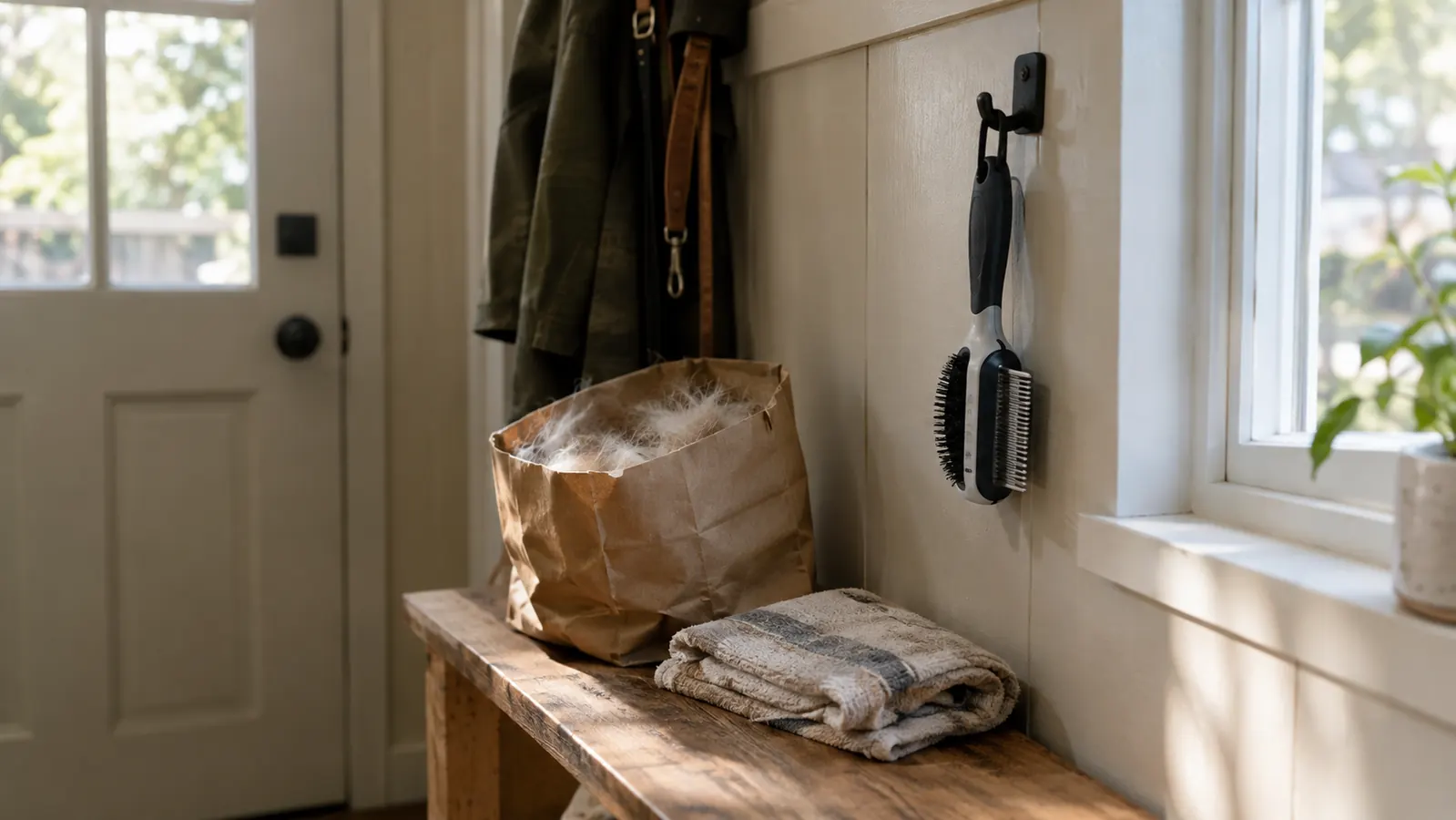
The two-head design also means one tool on the hook instead of two. My mudroom is small. The hook by the back door already holds the leash and the treat jar, so the Thunderpaws earned one hook while the FURminator went back in the drawer. Eight weeks in, the teeth show no sign of bending or dulling, the handle has not cracked, and I have not once reached for the FURminator when Otis came in from the yard looking like a second dog had shed on him. For a household with a heavy shedder, that daily convenience matters more than any single impressive pass.
I will be straight about the Thunderpaws' weak spots so the praise means something. Clearing the brush head takes a few swipes across an old towel, which is slower than the FURminator button. The handle is also straight, so during a long session I had to stop and shake out my hand more often than I do with the FURminator. Neither issue stopped me from reaching for it first, but both are real, and both are the reasons the FURminator took a couple of rows in the comparison table.
Where FURminator Wins
The FURminator is easier to keep moving, and that is not a small thing. When its teeth fill, which happens every few strokes on a dog in full shed, the FURejector button pops the whole plug of hair off in one motion. With the Thunderpaws I swipe the teeth through an old towel two or three times to clear them. It works fine, but it breaks the rhythm of the session. The FURminator handle also fits my hand better during long, slow work. The contoured grip sits lower and lets me brush without curling my wrist, and after a thirty-minute session my hand was noticeably less tired.
The blade edge also leaves a smoother finish on a coat that is already in good shape. Once Otis had been brushed every other day for a couple of weeks, the loose undercoat was mostly gone, and the FURminator picked up the short, fine hairs near the surface that the brush end of the Thunderpaws missed. After a pass with the FURminator, his coat looked groomed rather than just brushed. If your dog's coat stays tangle-free and your brushing is maintenance rather than rescue work, that finishing pass is a real advantage.
There is one more place the FURminator wins, and it surprised me. On cold mornings when Otis's back legs are stiff, he will not stand still for the rake and brush routine. The FURminator, with its single smooth head, is easier to use in short one-handed bursts while he is lying down. I could reach under him and work one small patch at a time without asking him to stand. The Thunderpaws needs two hands and a standing dog to flip ends comfortably, so on those mornings I reached for the FURminator.
One tool that cuts the tufts and the tangles
After eight weeks of side-by-side tests on a heavy-shedding Labrador mix, the Thunderpaws 2-in-1 pulled more undercoat per session and opened mats the FURminator skipped, and it costs less up front. See today's price and owner reviews on Amazon before you buy either one.
Amazon Check Today's Price on Amazon →Who Should Buy Which
Buy the Thunderpaws if your dog has a thick undercoat that mats between sessions, if you want one tool that both rakes and brushes, or if this is your first serious deshedding tool and you do not want to spend more for the established name. It is also the better choice for a fidgety dog, because the rounded rake teeth are more forgiving when the dog shifts mid-stroke. And if your storage space looks like mine, a single two-in-one handle beats two separate tools every time.
Buy the FURminator if your dog's coat stays smooth and tangle-free, if you already own one and it works for you, or if most of your brushing happens in a few long sessions during shedding season rather than a little bit every other day. The instant hair release and the contoured handle make it the more comfortable tool for patient, extended work. It is the tool I reach for when Otis is lying down on a cold morning and will only tolerate short passes, and on those days nothing beats the finish it leaves.
The Bottom Line After Eight Weeks
After eight weeks I am not going to tell you the FURminator is a bad tool, because it is not. On a calm dog whose coat is kept ahead of the shedding, it is efficient, comfortable, and it produces a beautiful finish. But when I walk into the mudroom and Otis follows me in, hoping for a brush, my hand goes to the Thunderpaws. It removes more hair per session, it opens the tangles that appear the moment life gets busy, and it costs less up front. Those three facts decided this comparison.
If you already own a FURminator and your dog's coat is healthy, keep it and save your money. If you are choosing between the two for the first time, though, the Thunderpaws is the one I would buy again. It is not the flashier name, and it asks a little more of you between passes, but it does the harder job better. In this house, with this heavy-shedding 68-pound Labrador mix, the Thunderpaws earned the hook in the mudroom. The FURminator lives in the drawer now, and it comes out on cold mornings when Otis will only let me brush him lying down.
The tool that outworked my old FURminator
The Thunderpaws 2-in-1 Deshedding Brush and Dematting Rake removed more hair on my dog and handled the tangles the FURminator could not, at a lower price. If it does not fit your routine, Amazon's return window has you covered. Check the current price and reviews.
Amazon Check Today's Price on Amazon →