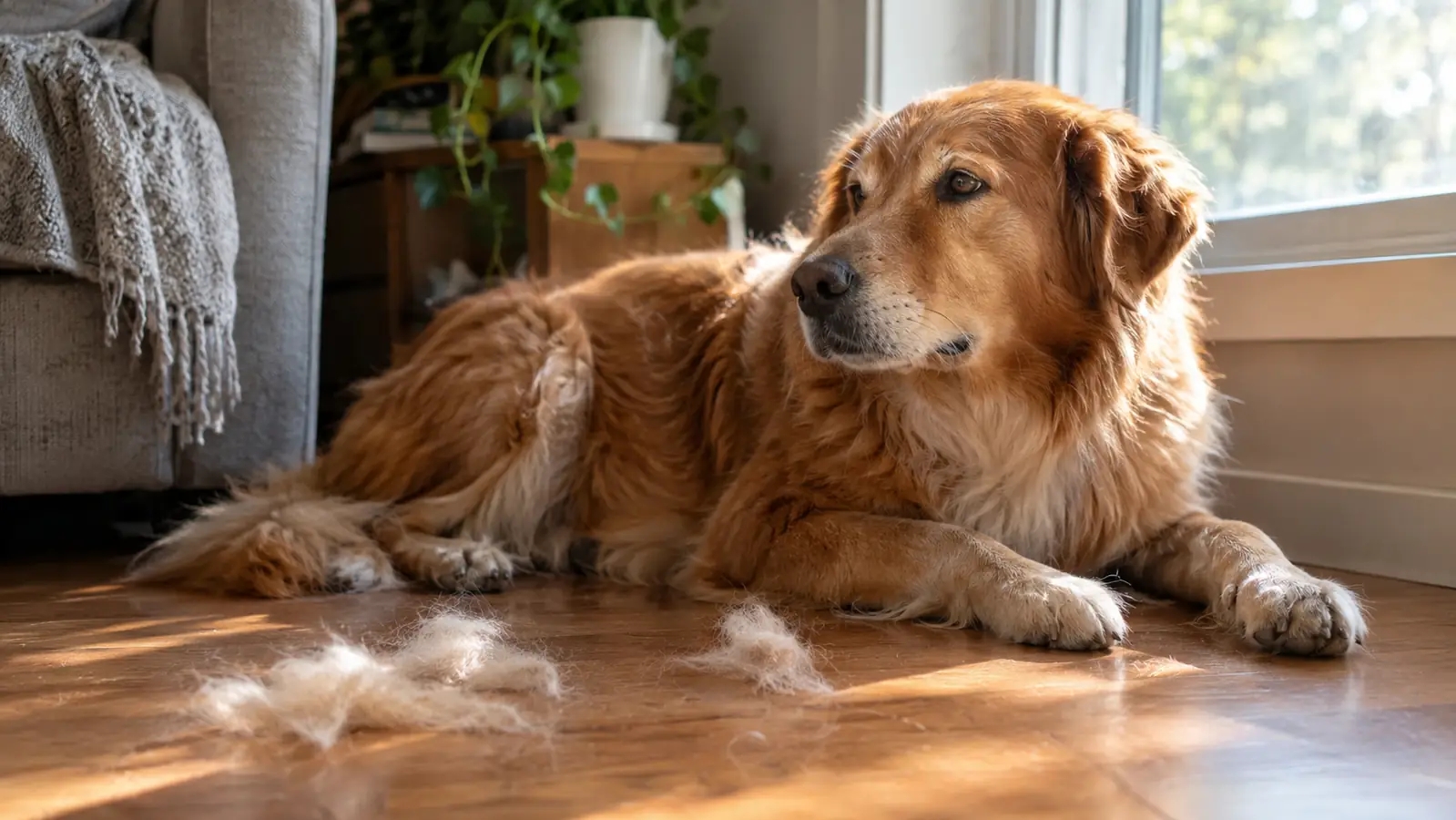
I bought the Thunderpaws deshedding brush because Otis, my seven-year-old, 68-pound Labrador mix, treats every spring like a full-time shedding job. We live in a two-bedroom house in Green Bay with hardwood downstairs, carpet upstairs, and a mudroom that collects more fur than dirt. By early May I was vacuuming the stairs twice a week and still finding tufts on my work pants before I left the house.
The listing photos show a patient dog on a bright grooming table and one clean sweep that peels away a tidy ribbon of fur. The real version has a dog who fidgets, a tool that takes two hands at first, and loose hair floating onto your jeans, your sleeves, and once, my coffee. I would have respected the Thunderpaws more if the listing had shown me that second picture. So this review comes at the product from the angle the marketing tends to skip: what it is actually like to live with this brush for eight weeks, in a normal house, with a normal dog and a cat who wants nothing to do with it.
One thing I want you to know before you read the star rating: the 4.4 average across more than twenty thousand Amazon ratings includes plenty of people who reviewed after their first satisfying session. I understand that impulse, because my first session was satisfying too. But a deshedding brush is a recurring chore, not a one-time fix, and the reviews that show up a month later are the ones worth reading. This is that longer view.
The Quick Verdict
Honestly? It is the most useful grooming tool in my mudroom, and it still is not the effortless, mess-free tool the listing suggests. It cut our fur problem by about two-thirds once I learned to use it properly.
Amazon Check Today's Price →You can't stop a Labrador mix from shedding. You can stop the fur from taking over your house.
Thunderpaws won't end shedding, and the listing oversells how tidy the process is. What it does well is pull the loose undercoat before it lands on your stairs, your couch, or the back seat of your car. If that is the job you need done, see today's price on Amazon.
Amazon Check Today's Price on Amazon →How I've Used It
Otis has the classic double coat of a Lab mix: a soft, dense undercoat that sheds in clumps and a coarser topcoat over it. He is not matted, because I stay on top of it, but from mid-April through June he sheds enough to stuff a throw pillow, and I am not exaggerating much. That undercoat comes out in soft handfuls that hold together like wool, which is oddly satisfying to remove. His topcoat sheds as individual hairs that float around no matter what, and no deshedding tool removes those, so it helps to want the right thing from the start.
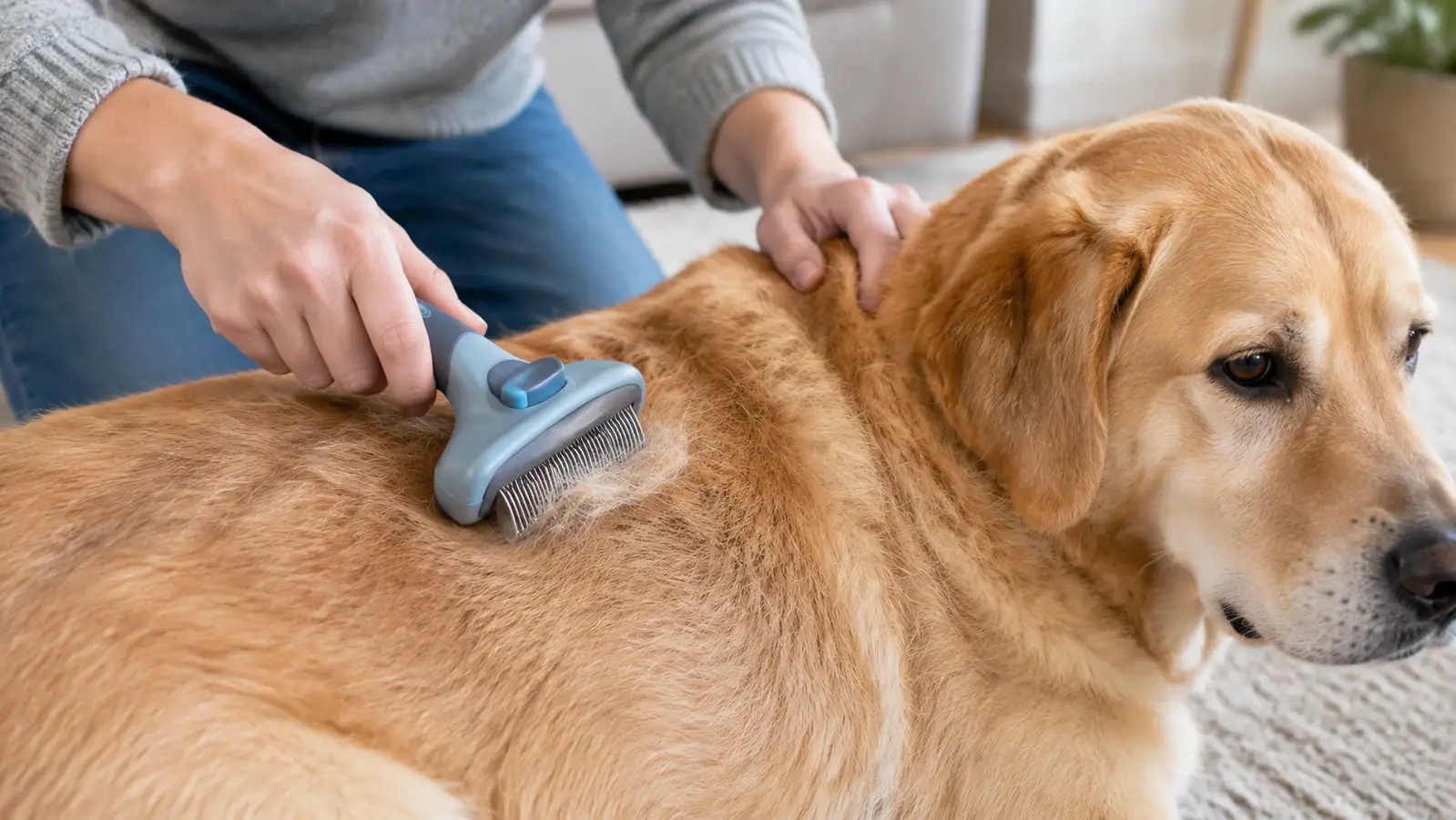
I used the Thunderpaws twice a week after his morning walk, roughly fifteen minutes per session. The first time, I pressed down and dragged fast the way the demo videos show. That scraped his skin and made him lean away. The moment I switched to shorter, overlapping strokes and let the tool find the undercoat instead of forcing it, he stood still long enough for me to cover his back, his sides, and the back of his rear legs in one session, which felt like a small victory.
The first two sessions produced the biggest piles. By the third week, the payoff settled into a steady, smaller harvest, which is exactly how a deshedding brush should behave once it has caught up with the undercoat that was already loose. I also learned to do this outside on the back steps whenever the weather allowed. Indoors, the slightest draft carried undercoat onto the nearest wall, and I once found a tuft on the kitchen ceiling that I still cannot explain.
What the Listing Photos Don't Show
The marketing photos make two things look easier than they are. The first is the dog. Every model in those shots is standing still on a grooming table while a professional makes long, graceful strokes. Otis is a good dog, but he is a 68-pound dog who would rather be at the fence line. I brush him on the floor or the back step, where he feels less trapped, and I accept that the last few minutes will involve him inching away while I follow. That is normal.
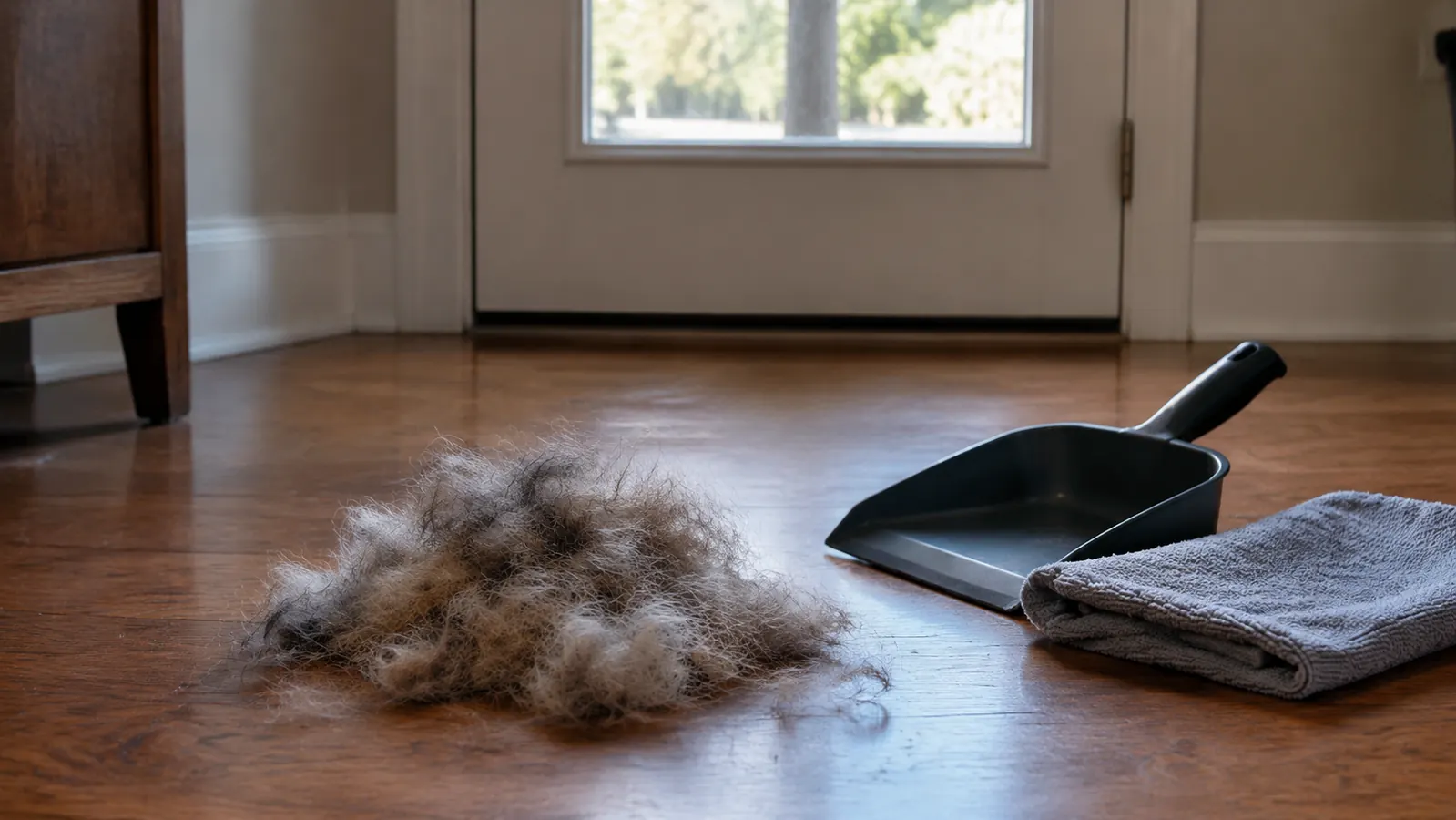
The second thing the photos skip is the cleanup. Fur does not fall into a neat pile. It lifts, drifts, and settles on whatever is downwind, including you. By the end of an indoor session I look like I lost a fight with a wool sweater. The tool collects fur along its working edge, and every few strokes I stop to pull the packed hair off with my thumb. The listing does not show any of that, and it should, because the mess is the trade-off that comes with the results.
I keep a plastic shopping bag, an old towel, and a damp cloth near the spot where I brush Otis. The bag catches the handfuls, the towel catches the dog, and the cloth wipes the edge between strokes once the worst of the fur is off. None of this is difficult. It is just more than the 30-second video suggests, and knowing that before you buy is the difference between feeling cheated and feeling prepared.
The Two Jobs, Honestly
The reason I chose this brush over a single-purpose deshedder is the two-in-one design. The deshedding edge does the heavy work on Otis's back and sides. The rake side is for light tangles, the kind that form behind his ears and at the base of his tail when he has been wet or dirty. Having both on one handle means one tool lives in the mudroom drawer instead of three, and I reach for it more because I do not have to search for the right one.
I will be straight about the rake side: it is for loose surface tangles, not for a coat that has been neglected for months. If a mat is tight against the skin, no handheld rake should go near it, because you can hurt the dog by accident. That kind of matting calls for clippers or a groomer and a conversation with your vet about how the coat got there. Thunderpaws is not rescue equipment, and it was never meant to be.
The For dogs and cats claim on the packaging also overpromises for a lot of households. Pepper, my five-year-old indoor tabby, is short-haired and does not need deshedding the way Otis does. I tried one gentle stroke along her back and got the look she usually saves for the vet carrier, then she jumped down and ignored me for an hour. If your cat already enjoys being brushed, this could work on a cat. I would not buy it expecting to convert one.
Where It Falls Short After Eight Weeks
The biggest honest limitation is the mess I keep coming back to. Thunderpaws removes fur but it does not contain fur. You will spend extra minutes clearing the tool, sweeping the floor, and picking hair off your clothes, and on a windy day you will do some of that outside, in the yard, where the fur simply becomes bird nesting material. Effective? Yes. Tidy? No. The two ideas do not travel together with a double-coated dog.
The second limitation is technique. This tool works when you let the working edge do its job, which means how you hold it matters more than the marketing lets on. Press too hard and you will scrape skin. Go too fast and you will glide over the undercoat and collect almost nothing. If you are not sure what the right pressure feels like, test the tool on your own forearm first, then keep the first sessions short while your dog learns to stand still for it.
Third, and this one is specific to my house: the dog and cat label overpromises. In eight weeks, Thunderpaws was a dog tool here. Pepper wanted no part of it, and I did not push her, because forced grooming ruins trust. A long-haired cat who already likes brushing might feel different. I am only telling you not to count on the cat side of the package until you meet your own cat.
What I Liked
- Removes loose undercoat that ordinary brushes slide over
- Two tools in one, so the grooming drawer stays simple
- Sturdy enough for weekly use; nothing has bent or flexed in eight weeks
- Visible reduction in fur on floors and stairs within two weeks
- Easy to clear between strokes once you accept that clearing is part of the job
Where It Falls Short
- Messier than the listing shows; fur gets airborne and lands on you
- You stop every few strokes to clear fur off the head
- The rake side handles only light tangles, not neglected coats
- The dogs and cats label overpromises for many households
- Technique matters; rush it or press too hard and you will scrape skin
After eight weeks and about sixteen sessions, I was vacuuming the stairs roughly half as often, and the canister was about a third as full. The trade is that I now spend fifteen messy minutes outside with a dog who would rather be anywhere else.
How to Use It Without Hating It
The best way to use this brush is short strokes, gentle pressure, and a goal of reducing, not eliminating. I work in sections: one side of the neck, then the shoulder, then the ribs, then repeat on the other side. I stop the moment the tool stops pulling undercoat easily, because chasing the last few hairs is how you end up with a raw spot and a dog who hides when he sees the brush.
I also learned to read Otis. When he starts shifting his weight, the session is done, even if I think another pass would help. Two calm ten-minute sessions a week beat one forced twenty-minute session every time, and a dog who tolerates grooming is the difference between a tool you use and a tool you hide in the drawer. The Thunderpaws is a good enough tool that the weakest link in the routine is usually me, not it.
What Eight Weeks Changed, and What It Didn't
I kept a simple log because I wanted to know whether the brush was doing something or just making me feel productive. In mid-April I was vacuuming the upstairs hall and stairs every other day. By the end of June, the same stretch needed it twice a week, and the vacuum canister was about a third as full when I emptied it. The stair runner looked visibly less furry by the second week and stayed that way. Those are the changes I can put numbers on.
Otis still sheds, and I want to be direct about that. A brush does not stop a double coat from shedding; it moves the shedding to a time and place of your choosing. The loose undercoat came out on my schedule, outside or on the back step, instead of landing on the carpet and the back seat of my 2016 CR-V over the following days. He still leaves hair on the car seats whenever he rides, but it is a normal amount now, not a layer.
What did not change is also worth naming. Pepper still sheds her short cat hairs, the kitchen counter still collects crumbs, and the ceiling tuft mystery was never solved. If you buy this brush expecting a fur-free house, you will be disappointed. If you buy it expecting less fur on the floor, the stairs, and the car seats, it delivers.
Alternatives I Considered
I did not buy the Thunderpaws on a whim. I looked at the best-known name in deshedding, the Furminator, and read a great many owner reviews before deciding. The Furminator has a devoted following, and for some coats it is the right answer. I wanted one tool that could also handle an occasional light tangle, and I liked the thought of a single handle and a single drawer over a growing collection of specialty brushes.
Before this brush, I had also tried a no-name undercoat rake from an online listing, the kind that arrives in packaging that reads like it was translated three times. It flexed the moment I put pressure on it, the edge never sat flat against Otis's coat, and it simply skated over his topcoat without reaching the undercoat. That experience is probably why the Thunderpaws felt like such a relief. It has real weight, the handle fits my hand, and it does not bend or wobble under a 68-pound dog who leans into the brush.
A rubber curry mitt is fine for a light shedder or a dog who loves being rubbed, but on Otis it only collected the hair it touched. It never reached the undercoat, and after a session with the mitt he would still shed the same amount onto the floor the next day. Different coats need different tools, and the honest takeaway from my eight weeks is that the Thunderpaws is the middle ground that fits the most households: better than a mitt at undercoat, more convenient than a specialty tool for most dogs.
Who This Is For
Buy the Thunderpaws if you have a double-coated or otherwise heavy-shedding dog and you are willing to brush twice a week during shedding season. It is for owners who want visibly less fur on the floor, the stairs, the furniture, and the car seats, and who understand that the brush is part of a routine rather than a replacement for one. Otis is the reason I own it, and eight weeks in, I would buy it again without hesitation.
Who Should Skip It
Skip it if your dog has a single short coat that sheds lightly, because you will not see enough payoff to justify the mess. Skip it if your dog is frightened of being groomed, since no tool helps if you have to corner the animal to use it. And if mats are already tight against the skin, do not buy this or any rake; that job belongs to a groomer, and the vet visit that should go with it comes first.
The honest bottom line: Thunderpaws is the first tool I reach for.
It has limits, and I have listed every one of them. If your dog sheds like Otis and you accept that results come with cleanup, this brush will do more for your floors, stairs, and car seats than any other grooming tool I have tried. See today's price on Amazon.
Amazon Check Today's Price on Amazon →